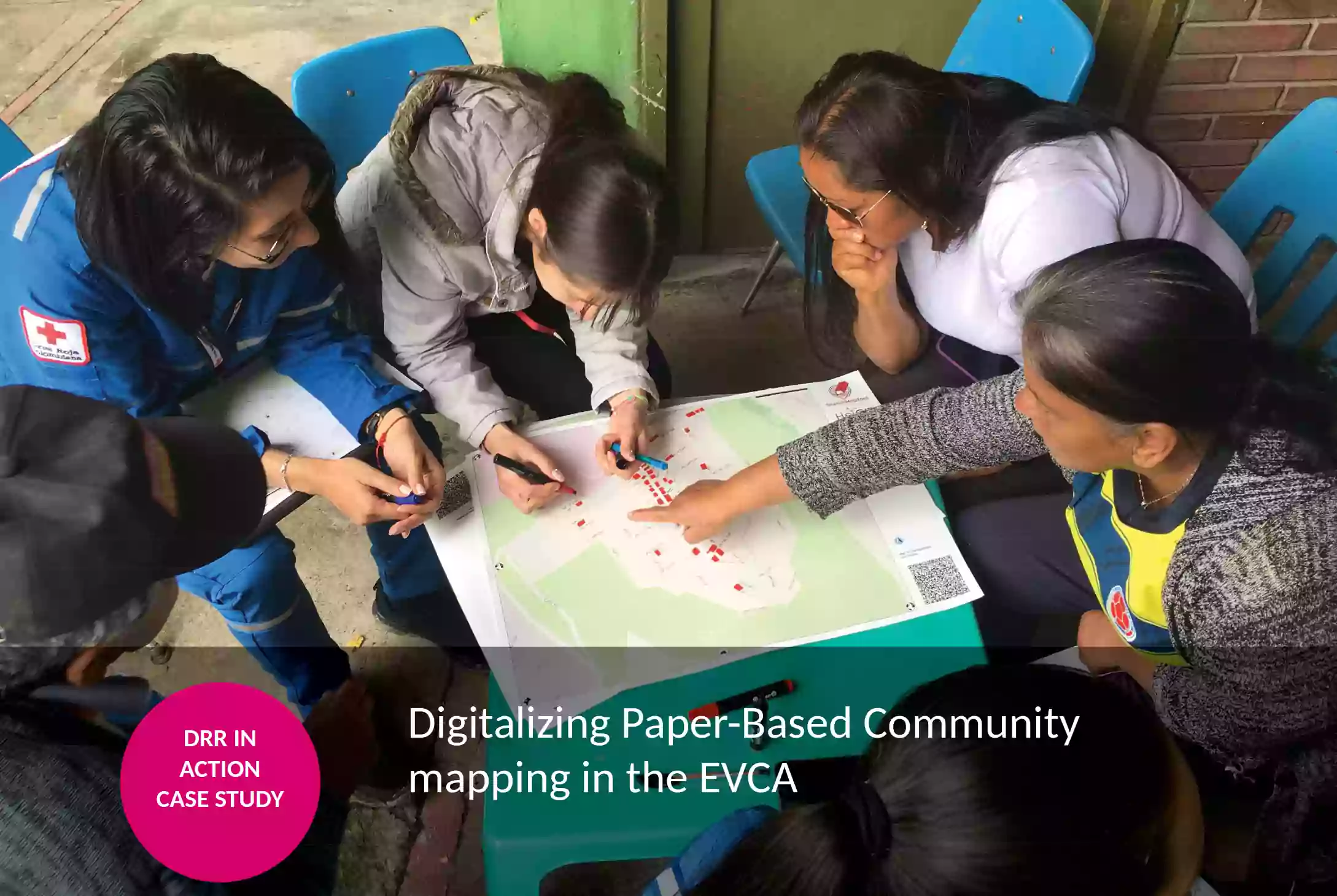
 Klipper, S (2024). DRR in Action Case Study: Digitalizing Paper-Based Community mapping in the EVCA.
https://preparecenter.org/resource/digitalizing-paper-based-community-mapping-in-the-evca/
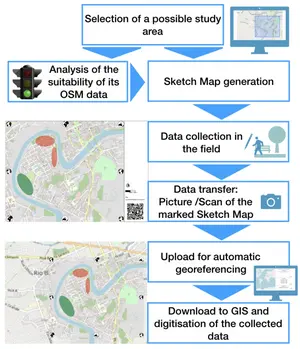
The Sketch Map Tool is an easy-to-use tool for participatory mapping through offline collection, digitization, and georeferencing of local data. The low-tech solution is designed to simplify the collection and analysis of local spatial knowledge and perceptions with pens and paper maps, the so-called Sketch Maps. The Sketch Map Tool is an open-source web application. It facilitates the creation, usage and the digitization of paper-based maps with OpenStreetMap and satellite data.
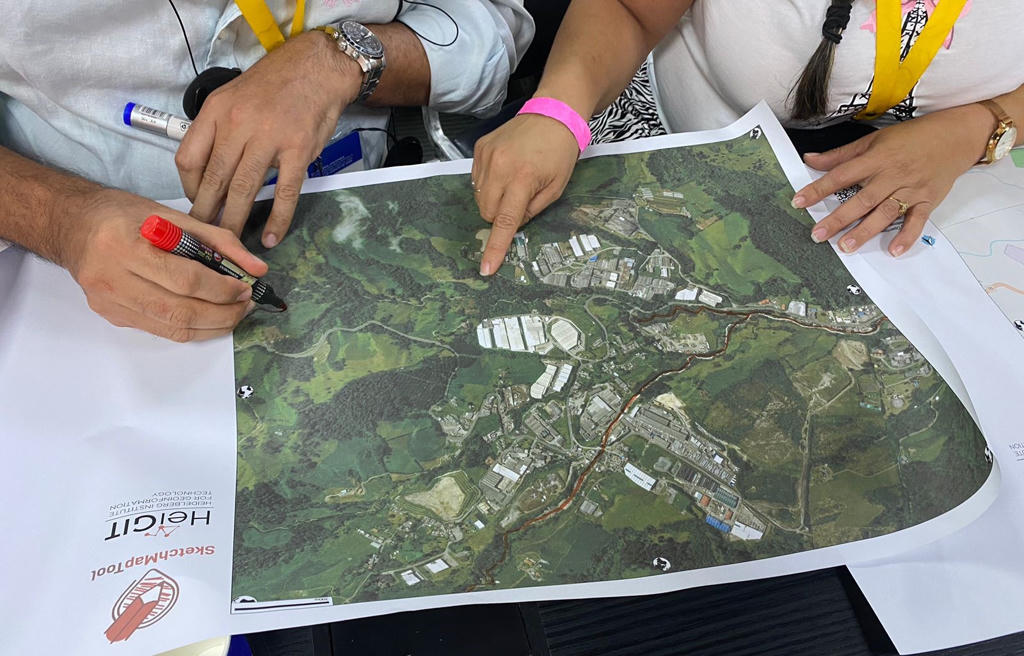
Das Sketch Map Tool unterstützt Anwender*Innen in allen wichtigen Schritten des partizipativen Kartierens, vom Anfertigen von Papierkarten bis zu deren Digitalisierung. Es ist dabei unabhängig von einer Internetverbindung.
Define your area of interest and your base map (OpenStreetMap (OSM), satellite imagery by ESRI or OpenAerialMap imagery (OAM)), look at the OSM Map Quality check provided by HeiGIT ohsome quality API and export the map as a PDF.
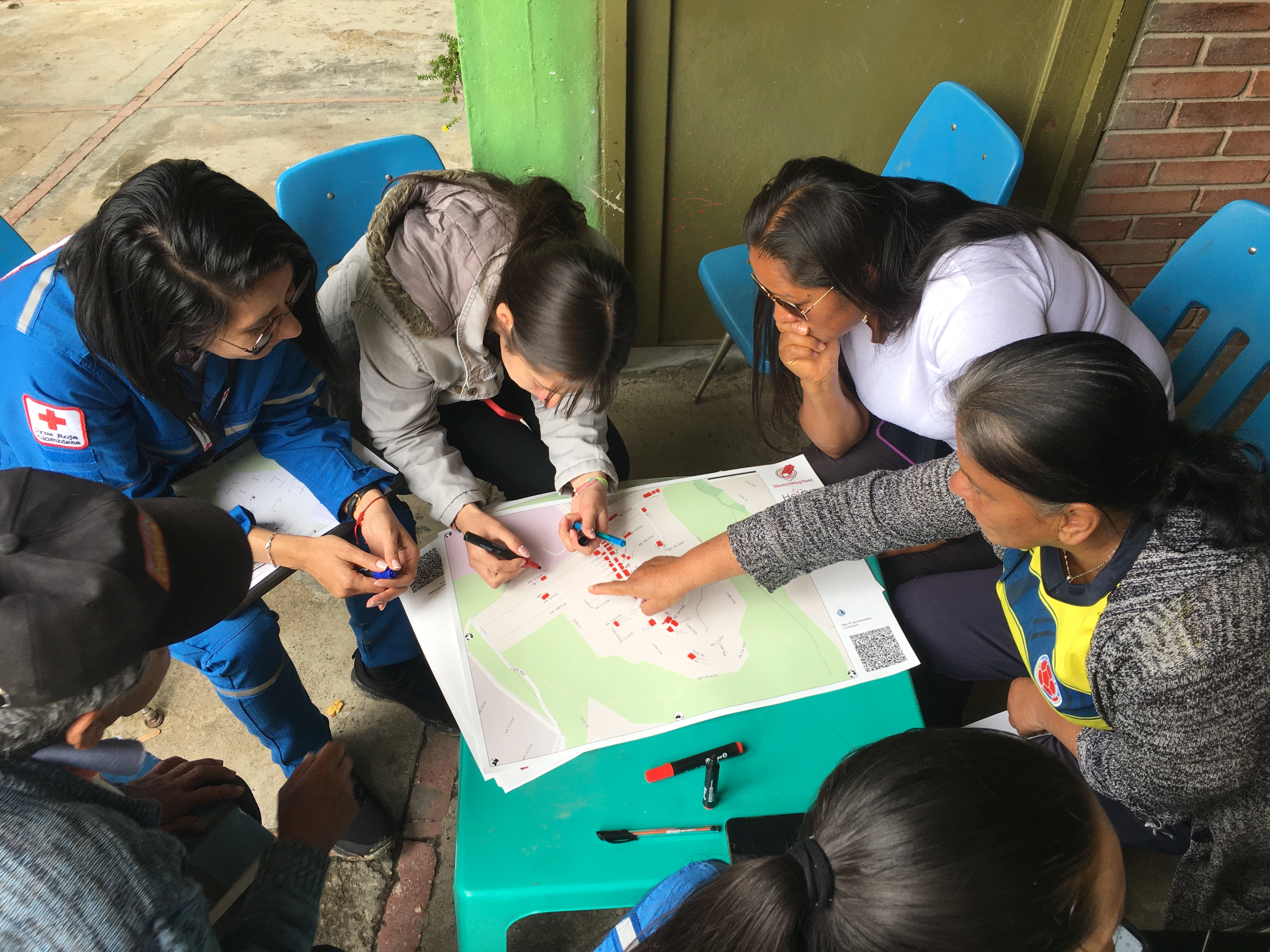
Offline data collection with local communities, either individually or as a group activity. Participants mark their local knowledge directly onto printed Sketch Maps with pens.
Scan or photograph your marked Sketch Maps, upload the images to the Sketch Map Tool and download collected markings (geojson and geotiff). The tool georeferences the Sketch Maps and detects the markings employing a fusion of computer vision algorithms and novel AI models. The results can then be used for further analysis in Geographic Information System software.

The Sketch Map Tool project has been developed in close cooperation between the HeiGIT and the GIScience Research Group from Heidelberg University with the generous contributions of several sponsors and support by partner organizations.
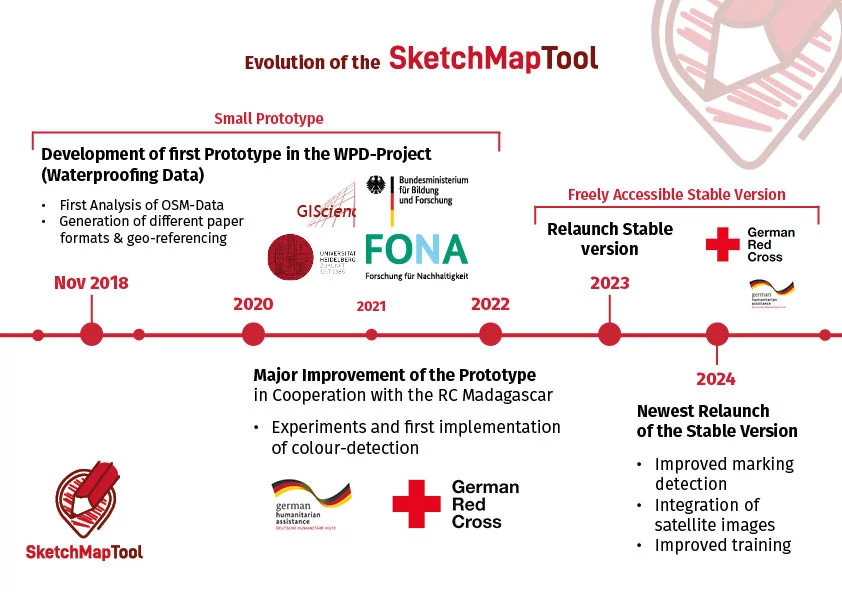
The development of the Sketch Map Tool began in 2018 as an idea and simple prototype in the Waterproofing Data project (funded by the Federal Ministry of Education and Research - BMBF). In 2021, this initial prototype received a major update, including an improved user interface and the first implementation of color detection (using computer vision)
Since then, the tool has been tested by humanitarian organizations worldwide, including in Germany, Chile, Colombia, Brazil, Mozambique, Madagascar, Honduras, Ghana, Kenya, and Sudan. Following its 2023 relaunch as a stable version, the Sketch Map Tool is now an official part of the HeiGIT tool suite.
The tool is continuously evolving to meet the needs of humanitarian actors:
The continuous development and adaptation of the Sketch Map Tool for humanitarian use has been made possible through a strong collaboration with the German Red Cross (GRC) and significant financial support from the German Federal Foreign Office within the framework of the "Global Project II." This project contributes to reducing the negative consequences of disasters for affected populations by extending strategic humanitarian topics and innovative approaches. Core maintenance of the tool and regular updates to the machine learning models are ensured by core funding from the Klaus Tschira Foundation (KTS).
The focus of the relaunch in 2024, once again funded within the framework of the Globalprojekt II, was the implementation of satellite images as a base map and the overall improvement of color detection, especially on satellite images. Additionally, general software stability was further ensured, and customized training materials designed to make the tool more accessible to end-users with different knowledge levels.
Unsere Vision ist eine Welt, in der Gemeinschaften weltweit dazu befähigt werden, lokale räumliche Informationen und Wissen mittels einer open-source, low-tech Lösung zum partizipativen Kartieren effektiv zu sammeln, zu kommunizieren und zu verwenden. Diese Lösung überbrückt die Lücke zwischen papierbasierter Datenerhebung und digitaler Analyse und Speicherung, mit dem Ziel, derzeitige und vergangene Zustände und Auffassungen kollaborativ zu visualisieren und zu analysieren. Hierdurch soll ein Bewusstsein geschaffen und zu einem transformativen Wandel in Gebieten, die von Herausforderungen im Bereich der Nachhaltigkeit betroffen sind, beigetragen werden.
If you have questions or would like to provide feedback, please reach out to the project team.


Eine detaillierte Schritt-für-Schritt-Anleitung zur Anwendung des Tools sowie häufig gestellte Fragen findest Du auf der Hilfe-Seite.
The code of the Sketch Map Tool is released on GitHub.
Auf der GIS-Trainigsplattfrom des IFRC Network, die von der HeiGIT gGmbH entwickelt wurde, gibt es fünf Übungen sowie Trainingsanweisungen, mit denen Du lernen kannst, wie man das Sketch Map Tool benutzt und wie Du mit den daraus resultierenden Ergebnissen umgehen kannst.
If you are interested in learning more about the concept and development of the Sketch Map Tool, consider watching the video of the lightning talk “OpenStreetMap Sketch Map Tool - The Future of OpenStreetMap Field Papers” at GeOnG 2020.
Additionally, Episode 7 "Mapping in der Humanitären Hilfe” of the podcast CHAtroom (in German) offers further insights. In this episode from the Center for Humanitarian Action (CHA), Dr. Natascha Bing (GRC) and Dr. Carolin Klonner (GIScience Heidelberg) discuss the importance of maps in disaster management and explore how the Sketch Map Tool can be utilized by humanitarian organisations.
Folgende wissenschaftliche Artikel über das Sketch Map Tool wurden veröffentlicht:
Klipper, S (2024). DRR in Action Case Study: Digitalizing Paper-Based Community mapping in the EVCA.
 Klonner, C., Hartmann, M., Dischl, R., Djami, L., Anderson, L., Raifer, M., Lima-Silva, F., Degrossi, L. C., Zipf, A., de Albuquerque, J. P. (2021): The Sketch Map Tool Facilitates the Assessment of OpenStreetMap Data for Participatory Mapping, 10(3): 130. ISPRS International Journal of Geo-Information. 10:130.
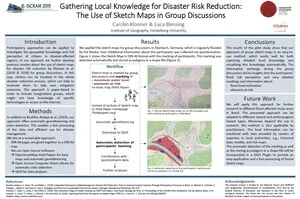 Klonner, C. & Blessing, L. (2019). Gathering Local Knowledge for Disaster Risk Reduction: The Use of Sketch Maps in Group Discussions. In: Proceedings of the ISCRAM 2019 Conference. Valencia, Spain, pp. 1397–1398.
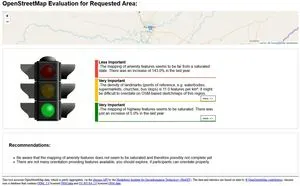 Klonner, C., Hartmann, M., Djami, L., Zipf, A. (2019). Ohsome OpenStreetMap Data Evaluation: Fitness of Field Papers for Participatory Mapping. In: Proceedings of the Academic Track at the State of the Map 2019. Heidelberg, Germany, pp. 35-36
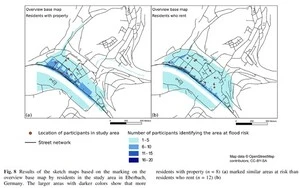 Klonner, C., Usón, T. J., Aeschbach, N., Höfle, B. (2021). Participatory Mapping and Visualization of Local Knowledge: An Example from Eberbach, Germany. In: International Journal of Disaster Risk.
HeiGIT gGmbH
Heidelberg, Deutschland
Email: sketch-map-tool@heigit.org
Internet: heigit.org